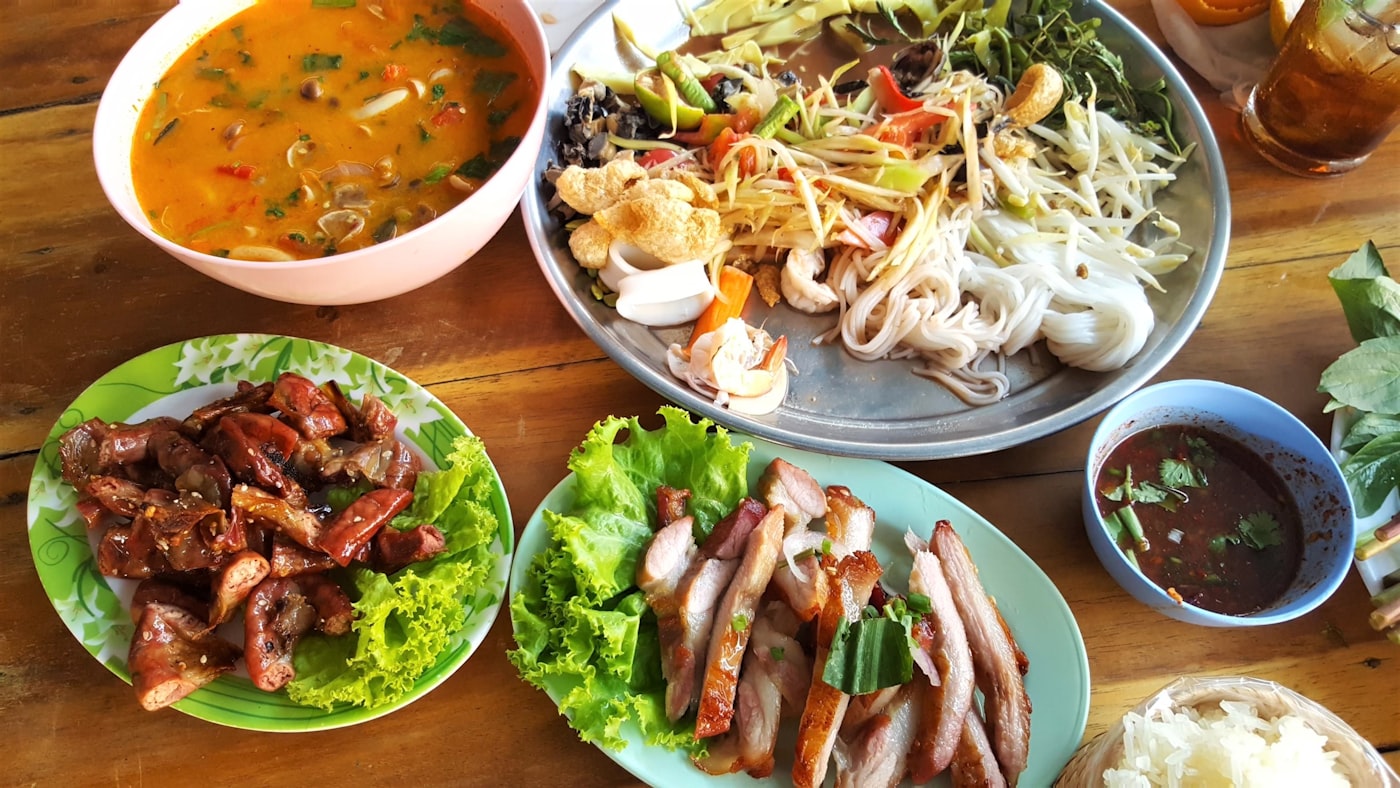
After six years in Phuket, I still eat Thai food almost every day, and I still occasionally learn something about it. The food culture here is layered in ways that take time to notice — Phuket's Hokkien Chinese heritage shapes the cooking in ways that distinguish it from Bangkok Thai food or anything you'd order at a Thai restaurant abroad. Understanding a few basics of how Thais actually eat and think about food will make your experience here richer and save you from a few common tourist errors (yes, using chopsticks for pad Thai in front of your Thai coworkers will get a gentle smile).
Thai Dining: Quick Reference
- Utensils: Spoon (right) + fork (left) for most dishes; chopsticks for noodle soups
- Eating style: Communal — dishes are shared, not individually ordered
- Tipping: Not mandatory; ฿20–50 for local restaurants, 10% at tourist spots
- Spice adjustment: "Phet nit noi" (a little spicy), "mai phet" (not spicy)
- Vegetarian code: "Kin jay" (เจ) — Buddhist vegan concept understood by most
- Bill call: "Check bin krap/ka" or make a writing gesture
- Phuket specific: Hokkien Chinese cuisine unique to the island — mee hokkien, oh tao, dim sum
The Basics: How Thais Actually Eat
Communal vs Individual
Thai meals are traditionally shared — a group orders multiple dishes to the middle of the table, and everyone takes from everything. This is how family meals and most casual restaurant dining works. When a Thai family invites you for a meal, don't expect a single plate in front of you — expect 5–8 dishes arriving over time, and take modest portions of everything rather than piling one dish on your rice.
In tourist restaurants, individual ordering is fine and expected. At local rice shops (khao gaeng), you typically choose from the pre-cooked dishes displayed behind glass — point at 2–3 things and they'll serve them over rice. Solo dining is perfectly normal here.
Spoon and Fork, Not Chopsticks
This surprises many visitors: standard Thai food (rice dishes, curries, stir-fries) is eaten with a spoon in the right hand and fork in the left. The fork pushes food onto the spoon; the spoon goes in your mouth. Chopsticks (ตะเกียบ, ta-giap) are reserved for noodle soups like kuay tiew, boat noodles, or Chinese-influenced dishes. Using chopsticks for a plate of green curry and rice is the food equivalent of wearing a swimsuit to a temple — technically no rules broken, but you'll get a quietly amused look.
Phuket's Unique Food Culture: The Hokkien Legacy
What makes Phuket's food scene genuinely special — and different from anywhere else in Thailand — is the 200-year Hokkien Chinese influence from the Peranakan/Baba-Nyonya communities who came to work the tin mines. Their cuisine fused with southern Thai cooking to create dishes you simply won't find on menus in Bangkok or Chiang Mai.
Mee Hokkien (หมี่โหว่เกี้ยน)
Thick yellow wheat noodles stir-fried with squid, pork, soy sauce and shrimp paste. The quintessential Phuket dish. Available at Thalang Road Walking Street on Sunday evenings.
Oh Tao (โอ้เต้า)
Oyster pancake with egg and tapioca starch, served with a sweet chilli sauce. Best version at the Ranong Road market shophouses from 6am (cash only).
Dim Sum (ติ่มซํา)
Phuket's dim sum is among the best outside China in Southeast Asia. Siew mai, har gow, turnip cake, fried taro balls — best in Phuket Town's early morning shophouses.
Khanom Jeen (ขนมจีน)
Rice-flour noodles (made fresh daily) served with various curry sauces. Typically a breakfast or brunch dish. The southern Thai crab curry version in Phuket is excellent.
Satay (สะเต๊ะ)
Phuket satay has a richer, more coconut-heavy marinade than Bangkok versions. The peanut sauce here is also sweeter and thicker. Best at Rawai seafood market or Malin Plaza.
Jay Food (เจ)
Buddhist vegan cuisine, particularly abundant during the Vegetarian Festival (October). Look for the yellow "J" flag. Many restaurants serve jay food year-round in Phuket Town.
Tipping in Phuket Restaurants
Thailand doesn't have a strong tipping culture — but Phuket's tourist economy has created more tip-awareness than you'll find in most Thai cities. The practical guide:
| Venue Type | Standard Practice | Amount |
|---|---|---|
| Street food stall (market) | Not expected; not necessary | Round up if you feel like it |
| Local khao gaeng rice shop | Not expected | — |
| Mid-range Thai restaurant | Appreciated, not required | ฿20–50 or loose change |
| Tourist restaurant (beachfront etc.) | Common, 10% expected by staff | ฿50–100 or 10% if good service |
| Fine dining / upscale | Common; service charge usually added | ฿100–200 or 10% if no service charge |
| Delivery (Foodpanda/Grab) | Optional; helps driver significantly | ฿20–30 cash or in-app |
Important note: if a restaurant adds a service charge to your bill (common at tourist and upscale spots), that charge typically goes to the house, not split with staff. A separate small cash tip to your server is appreciated and goes directly to them.
Navigating Spice Levels
Real Thai food — not the tourist version — is genuinely hot. Southern Thai food (Phuket's local cuisine) is notoriously spicier than central Thai food. A bowl of gaeng tai pla (southern Thai fish kidney curry) can be incapacitating if you're not used to chilli. Useful phrases:
| Thai Phrase | Meaning | When to Use |
|---|---|---|
| ไม่เผ็ด (mai phet) | Not spicy | When you genuinely can't handle chilli |
| เผ็ดนิดหน่อย (phet nit noi) | A little spicy | When you want flavour without fire |
| เผ็ดปกติ (phet pokkati) | Normal spicy | When you want the real version |
| เผ็ดมาก (phet mak) | Very spicy | Know what you're asking for |
| อร่อย (aroy) | Delicious | Always say this after a good meal |
| เก็บตังค์ / เช็คบิล (check bin) | Bill please | Combined with writing gesture |
Dietary Restrictions in Phuket
Vegetarian and Vegan
The concept of "kin jay" (เจ) is the Buddhist vegan equivalent that Thai people understand immediately — no meat, no fish, no eggs, no strong-smelling vegetables (garlic, onions in the strict version). Many Phuket Town restaurants fly the yellow "J" flag and serve this food. It's more useful than saying "vegetarian" (mangsawirat), which Thais sometimes interpret as "no red meat but fish sauce is fine." For strict vegetarians, be explicit: "mai sai nam pla, mai sai oyster sauce" (no fish sauce, no oyster sauce).
Halal
Phuket has a significant Muslim community, particularly on the east side of the island and in the Koh Yao islands. Halal food (look for the green crescent/halal certification sign) is available across Phuket — the Muslim fishing communities of Chalong, Rawai and Ao Yon area have several excellent halal seafood restaurants. The Indy Market at Saphan Hin on weekends has a strong halal food section.
Shellfish and Seafood Allergies
This is the most dangerous allergy in a Thai food context. Shrimp paste (kapi) is in almost every southern Thai curry paste. Fish sauce (nam pla) is in nearly every savoury dish. Oyster sauce is a stir-fry staple. If you have a genuine shellfish or seafood allergy in Phuket, you need to be explicitly clear — and eating at local market stalls where cross-contamination is inevitable is genuinely risky.
Market Etiquette in Phuket
Phuket's best food is at the markets. Key etiquette:
- Point and gesture: You don't need Thai to order at most market stalls. Point at what you want, hold up fingers for quantity, and smile.
- Don't haggle at food stalls: Food prices are fixed in Thai markets. Haggling at a ฿50 rice stall is insulting and unnecessary.
- Eat where you stand, or find a seat: Walking and eating simultaneously is considered slightly rude, particularly near temples. Find a stall with seats or eat at the side.
- Respect the queue: At popular stalls (like the Sunday dim sum in Phuket Town), Thais queue patiently. Don't try to jump ahead.
- Cash only at most market stalls: Cards and QR code payment are increasingly accepted, but small stalls often want cash. Carry ฿20/฿50/฿100 notes.
The Key Phuket Food Markets
For a full guide see our Phuket Food Guide, but the essential markets:
- Thalang Road Walking Street (Lard Yai), Phuket Town: Sunday evenings, 4–10pm. Best market for authentic Phuket food — mee hokkien, oh tao, satay, dim sum, mochi, and local desserts.
- Ranong Road morning market, Phuket Town: Daily 6–10am. The market Phuket residents actually use. Oh tao and dim sum from early morning. Cash only, no English menus, genuinely local.
- Chillva Market (Yaowarat Road): Thursday–Sunday evenings. More modern, hip vibe, some street art. Mix of food and retail stalls. Good for families.
- Rawai Seafood Market: Daily. Buy fresh catch from the vendors, take it to the adjacent restaurants who'll cook it for you (small cooking fee). One of the best value fresh seafood experiences in Phuket.
Need area-specific food recommendations or help finding your neighbourhood's best local stalls? Ask us — first question free.
Ask a free question →